

And they heard the sound of the LORD God walking in the garden in the cool of the day, and the man and his wife hid themselves from the presence of the LORD God among the trees of the garden. But the LORD God called to the man, and said to him, “Where are you?” And he said “I heard the sound of you in the garden, and I was afraid, because I was naked; and I hid myself.” He said, “Who told you that you were naked? Have you eaten of the tree of which I commanded you not to eat?”
— Genesis 3:8-11
I was unloading the dishwasher a couple months ago when a song popped into my mind that I haven’t heard since the late ’90s. Like Tom Cruise in Jerry Maguire singing a couple lines of Tom Petty’s “Free Fallin’”, I sang a line or two, then trailed off into a choppy hum of the melody.
It bugged me. What were those words? I remembered a couple lines and thought — maybe there’s something in those lyrics I should recall.
I Googled the line I thought must be the song title: “What if God Was One of Us? + song + lyric”. And voilà! The lyric to the song, “One of Us”, by songwriter Eric Bazilian, made memorable by singer Joan Osborne:
“What if God was one of us, just a slob like one of us, just a stranger on the bus, tryin’ to make His way home?”
I thought, well, that’s kind of mean — comparing God to a slob! What’s with this song? Why don’t I remember it being offensive?
It’s catchy, yes, but it’s also deeply telling. The song’s allure lies in its question: What if God were human — subject to pain and all other human emotion. Ordinary. One of us. And I think the reason it lingers in my mind is because the answer is precisely what faith has declared from the beginning: “HE WAS!”
The God Who Became “One of Us”
Osborne’s lyrics imagine a distant God made suddenly close — a God who might stumble through daily life unnoticed. But that isn’t just imagination. That’s the Gospel. In Jesus Christ, God did become one of us — not metaphorically, but literally. The Word made flesh.
In the beginning was the Word, and the Word was with God, and the Word was God. All things were made through him, and without him was not anything made that was made. In him was life, and the life was the light of men. The light shines in the darkness, and the darkness has not overcome it
— John 1:1-5
He walked dusty roads, got blisters, laughed, wept, and grew tired. He was misunderstood, rejected, and betrayed. He knew hunger and thirst. He knew grief. He knows exactly what it means to be human — every joy and every ache.
The mystery of the Incarnation is that Jesus was both fully God and fully human. We can’t comprehend it, yet it is through this divine paradox that the chasm created by Adam’s disobedience was bridged. By being both, Jesus reunited heaven and earth, acting as the Second Adam who restores what was broken by the first. In His life, death, and resurrection, He restored our connection to God.
Think about it: God became man to offer Himself as an eternal, living sacrifice. He was born to die — not as an end, but as the means to open the door to new life.
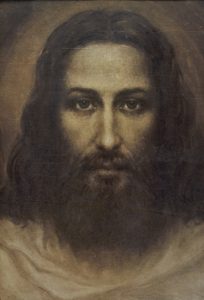
“If God Had a Face…”
Another line from the song asks:
“If God had a face, what would it look like?”
Scripture answers this question beautifully and painfully. The prophet Isaiah foretold the face of the Messiah several hundred years before his coming, not as handsome or majestic, but as one from whom people would turn away:
He had no beauty or majesty to attract us to him…He was despised and rejected by men, a man of sorrows, familiar with suffering.
— Isaiah 53:2-3
The face of God is not the flawless image our culture idolizes. It is the face of compassion worn thin by love, lined with grief for a world that has forgotten its Creator. The face of Christ, the Suffering Servant, shows us that God’s glory is not distant splendor — it is self-giving love.
And yet, as Rolling Stone critic Paul Evans observed at the time, Osborne’s song “imagines a God as hurt as any human.” That single line captures what so many people today fail to understand: the reality that God feels — that the Creator of the universe is not cold or indifferent but deeply moved by human pain.
Why Can’t We Picture God Anymore?
Maybe that’s the real question behind the song — why can’t we picture God anymore?
Perhaps the problem isn’t that we can’t see God’s face; it’s that we won’t consider His pain.
Our world is full of suffering, and it’s easy to look at brokenness and assume God is absent — or worse, indifferent. Yet the truth is that God’s heart aches for His creation. He experiences the full weight of our sorrow, and what hides His presence from us is our failure to recognize the depth of His compassion.
We don’t recognize that face — ordinary, bruised, tear-streaked — because we expect divinity to look like power and perfection. But God’s face is revealed in love that endures pain for our sake.
We are made in His image, which means something of His nature is written into us: our longing for love, our ability to forgive, our desire for goodness and beauty. When we forget that, when we turn away, we feel the absence — not because God is gone, but because we’ve stopped looking.
That’s what sin really is: not just wrongdoing, but separation. Every time we chase comfort, control, or false truth instead of the living God, we move further from His presence. Yet even there, He doesn’t stop reaching.
The Substitutes We Choose
Today, many call themselves spiritual but not religious — seeking transcendence without commitment, meaning without relationship. I used to be there myself. It felt freeing, even enlightened, to think of “the universe” as divine energy or a higher consciousness that we could also “master.” But over time, that vague spirituality became impersonal — and lonely.
If God is merely “the universe,” then He cannot love. He cannot suffer. He cannot feel. That’s not the God revealed in Scripture. The true God is personal — a Father who pursues His children, a Son who suffers for them, and a Spirit who dwells within them.
It’s no wonder our world feels lost. We crave connection but refuse communion. We trade the Living God for a mirror of our own making — and then wonder why we feel unseen.
The Stranger on the Bus
And so we return to Osborne’s haunting question:
“What if God was one of us — just a stranger on the bus, tryin’ to make His way home?”
In Jesus, He was. He is. Still today, He rides alongside us in the stranger, the poor, the lonely, the suffering. The question is not whether God is with us, but whether we recognize Him when we see Him.
From Eden to Bethlehem to Calvary and through His Spirit, God continues to draw us to Himself — walking with us, calling us home. Emmanuel: God with us.