
Mercy, Me.
There are a few lines in the hit song I Can Only Imagine by MercyMe that grip me every time I hear them:
Surrounded by Your glory
What will my heart feel?
Will I stand in Your presence
Or in awe of You be still?
More than lyrical musing, these words point to a serious biblical question we all ask at some point:
What will happen when I meet my Maker?
Surrounded by Your Glory
Scripture tells us that we will see God in all His glory. The power of that encounter is described throughout the Bible.
Many of us will not be ready for such light all at once — which is why God, in His mercy, even provides the cleansing grace of Purgatory to prepare us for His presence.
In the unveiled presence of God, the human heart trembles. Even the strongest fall to their knees. His light can blind us with its truth.
I think of Saul of Tarsus—who would later become St. Paul—struck blind on the road to Damascus by a light from heaven that changed the course of his life.
And I picture Moses coming down from Mount Sinai carrying the stone tablets of the Law. God had led him up that mountain and there revealed His glory as He gave His commandments to His people Israel. When he returns from the mountain to his people, Moses’ own face shines from his encounter with God—and they are afraid to come near him. Even reflected glory can overwhelm the human heart.
Yet God reveals His glory in mercy—drawing us toward Him not through terror, but through compassion, forgiveness, and love.
Mercy, as I once heard it explained, is the love we need most at the moment we least deserve it.
That He would even allow us to imagine standing in His glory is itself a gift.
Mountain of Mercy
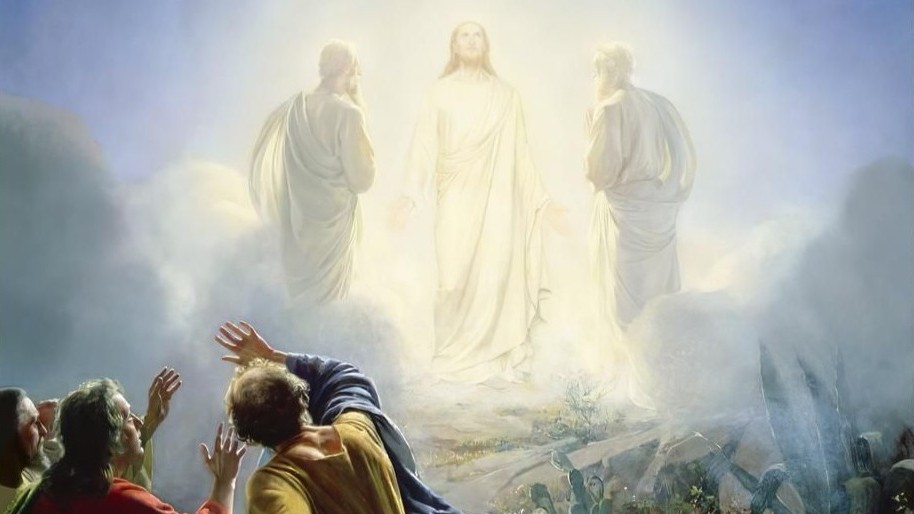
That is why the Gospel account of the Transfiguration of Jesus always astonishes me. Jesus takes His disciples Peter, James, and John up another high mountain. What they witnessed and later recorded was extraordinary.
“His face shone like the sun.” (Matthew 17:2)
His garments became dazzling white. Moses and Elijah—representing the Law and the Prophets—appeared in glory beside Him. A cloud overshadowed them. The Father’s voice spoke.
They witnessed His glory — and were amazed.
And Peter, fumbling in the aftermath of the revelation, asked Jesus if they should pitch tents for them right then and there.
But as Jesus leads them down the mountain, He presses them with this command:
“Tell no one the vision, until the Son of man is raised from the dead.” (Matthew 17:9)
What was the point of Jesus permitting these three fishermen to see Him in His glory before their death?
It was not meant to be revealed — not yet.
In His mercy, our Lord was preparing and strengthening their hearts in advance, so that when they saw Him beaten, mocked, and crucified, they would remember the glory they had witnessed on the mountain and not lose hope.
They would need it later—
when His face was bruised instead of blazing,
when His garments were stripped instead of radiant,
when the voice from heaven was replaced by the jeers of a crowd on Calvary.
They were given the gift of seeing Him in His glory so they could endure the scandal that was to come.
They were shown light so they would not lose faith in the dark.
An Echo in Linen from the Tomb
God has never stopped giving His people glimpses of His glory.
Not always in dazzling light on mountaintops, but in quieter ways — through miracles, mysteries, and the open channels of grace He left us in the sacraments.
And every now and then, something appears that makes me stop in wonder all over again.
For me, one of those things is the Shroud of Turin—a linen burial cloth believed to have wrapped Christ’s body when He was placed in the tomb, known in historical records since the 1300s.
A simple piece of linen bearing the faint image of a crucified man. Not painted. Not dyed. Not explained by medieval artistry.
But it wasn’t until the cloth was photographed in 1898 that an even deeper mystery emerged. The photographic negative revealed something astonishing: a detailed positive image — as if the linen itself had somehow been marked by light.
Scientists continue to puzzle over how the image was formed. It does not behave like pigment. It does not soak into the fibers like paint. It rests only on the very surface of the cloth.
Hotly debated? Absolutely.
Universally accepted? No.
But astonishing all the same.
Many believe the image may have been formed in a burst of radiant energy at the moment of the Resurrection — the power of God’s own light, His glory, leaving its mark upon the cloth.
An echo from the tomb.
Being Prepared for Glory
Peter, James, and John saw it in advance.
We are given glimpses differently.
In Scripture.
In the sacraments.
In moments when grace breaks through the ordinary.
Sometimes in mysteries that leave us wondering.
But all of these are only hints.
As St. Paul the Apostle reminds us:
“For now we see in a mirror dimly, but then face to face.” (1 Corinthians 13:12)
The full truth of God’s glory is not something we will behold from a distance.
One day we will stand in it.
Unveiled.
What will I do when I meet my Maker?
Will I stand in His presence?
Or fall to my knees?
I can only imagine.